Best CPU for RTX 5090: The Right Pick for 4K, 1440p High-Refresh and Every Budget
The RTX 5090 is a $1,999 graphics card (NVIDIA’s launch price) with 21,760 CUDA cores, 32 GB of GDDR7 memory, a 575 W power rating, and a 1,000 W system power requirement. It is the fastest gaming graphics card you can buy — and that changes the CPU question in both directions. At 1440p high-refresh it renders frames so fast that even excellent CPUs become the ceiling, and at 4K it is so powerful that CPU differences shrink to single digits in most games — but not to zero, and not in every game.
This guide names a specific CPU for each situation, using published benchmark data rather than a theoretical bottleneck percentage. Every performance figure is attributed to the reviewer who measured it, and every price is either a launch price or a retailer price we checked on October 24, 2026. Where a figure was measured with a different graphics card, the article says so.
Quick answer — the best CPU for RTX 5090:
- Best gaming CPU: AMD Ryzen 7 9850X3D — the fastest gaming processor in Tom’s Hardware’s RTX 5090-based testing. The Ryzen 7 9800X3D is within about 3% for $20 less, so buy whichever is cheaper on the day.
- The baseline for most new builds: AMD Ryzen 7 9700X — treat this as the floor for a balanced 5090 system; it fully feeds the card in most games at most resolutions.
- Best budget pick: AMD Ryzen 5 9600X — only for a pure-4K build on a strict budget, and even there it is the absolute floor, not a recommendation.
- Already own a Ryzen 7 7800X3D? Keep it. It remains an excellent pairing at every resolution, and at current prices the upgrade math no longer works.
- Best Intel option: Intel Core Ultra 7 265K for gaming + work; the flagship Core Ultra 9 285K only makes sense if productivity comes first.
- Gaming + serious creation: Ryzen 9 9950X3D — no faster than the X3D gaming chips in games, far faster in multi-core work. The 12-core 9900X3D sits awkwardly between it and the 9800X3D.
How Much CPU Does the RTX 5090 Actually Need?
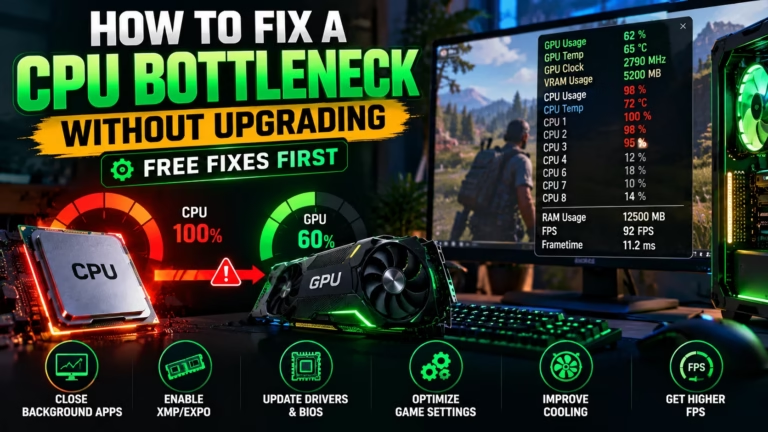
A bottleneck means one part of your PC is waiting on another: if your GPU sits below full utilization while CPU cores are maxed out, the CPU is the limit; if the GPU is at 97–100%, the card is the limit — which is what you want, because the card is where your $1,999 went. With the RTX 5090, where that line falls depends on your monitor more than on any spec sheet:
- 4K is this card’s home turf, and it is GPU-heavy. The 5090 does the overwhelming majority of the work; mid-range CPUs keep up, and flagship CPUs mostly polish 1% lows — except in unusually CPU-demanding games, where the gap survives even at 4K (see the resolution section).
- 1440p high-refresh (165 Hz and above) is where CPU choice genuinely matters for this card, more than with any weaker card. The 5090 renders frames so quickly at 1440p that the CPU becomes the ceiling in esports, simulation, strategy, and MMO titles — and Tom’s Hardware’s current hierarchy, tested with an RTX 5090 itself, shows the spread between the fastest and slowest current CPUs is still enormous at 1080p-class CPU loads.
- 1080p is the edge case: the 5090 is far more card than 1080p needs, and almost any pairing is CPU-limited there by design. It only makes sense for competitive play at extreme refresh rates — where the 9850X3D is the answer.
Treat any single “bottleneck percentage” — including the estimate from our own bottleneck calculator — as a starting point, not a verdict. The calculators in this niche disagree with each other in public, and some of the guides ranking for this very query publish calculator output dressed up as measurements: one prominent page’s own disclosure admits its guide “is based on desk research, not hands-on lab testing,” despite a title promising “real bottleneck data.” Use percentages to shortlist, then run the two-minute test later in this guide on your own games. Our full reasoning is here: are bottleneck calculators accurate?
The Best CPUs for RTX 5090 at a Glance
| CPU | Best for | Cores / Threads | Boost clock | Cache (L3) | Platform | Price basis |
|---|---|---|---|---|---|---|
| Ryzen 7 9850X3D | Best gaming; fastest in testing | 8 / 16 | 5.6 GHz | 96 MB | AM5, DDR5 | $499 at Best Buy (Oct 24, 2026) |
| Ryzen 7 9800X3D | Best gaming value; ~3% behind | 8 / 16 | 5.2 GHz | 96 MB | AM5, DDR5 | $479 at Best Buy (Oct 24, 2026) |
| Ryzen 7 9700X | The baseline pick for most builds | 8 / 16 | 5.5 GHz | 32 MB | AM5, DDR5 | $341 at Best Buy (Oct 24, 2026) |
| Ryzen 5 9600X | Absolute floor; pure-4K only | 6 / 12 | 5.4 GHz | 32 MB | AM5, DDR5 | $226 at Best Buy (Oct 24, 2026) |
| Ryzen 7 7800X3D | Previous-gen X3D; keep if owned | 8 / 16 | 5.0 GHz | 96 MB | AM5, DDR5 | $420 at Best Buy (Oct 24, 2026) |
| Ryzen 9 9950X3D | Gaming + heavy creation/streaming | 16 / 32 | 5.7 GHz | 128 MB | AM5, DDR5 | $624 at Best Buy (Oct 24, 2026) |
| Ryzen 9 9900X3D | 12-core gaming + creation middle | 12 / 24 | 5.5 GHz | 128 MB | AM5, DDR5 | $599 at Best Buy (Oct 24, 2026) |
| Intel Core Ultra 7 265K | Intel all-rounder; 4K value | 20 (8P + 12E) / 20 | 5.5 GHz | 30 MB | LGA1851, DDR5 | $394 launch price (street not verified) |
| Intel Core Ultra 9 285K | Productivity-first Intel flagship | 24 (8P + 16E) / 24 | 5.7 GHz | 36 MB | LGA1851, DDR5 | $529.99, marketplace listing (Oct 24, 2026) |
Specifications: NVIDIA, AMD and Intel official product data (9900X3D cache and 9850X3D specifications via review-site spec tables reproducing manufacturer data — see the notes below the table). Prices are launch prices unless a retailer and date are shown; street prices move, so confirm before you buy.
Best Gaming CPU for RTX 5090: Ryzen 7 9850X3D (and the 9800X3D Value Case)
The Ryzen 7 9850X3D is the fastest gaming CPU in current published testing — and unlike the situation a year ago, that claim now rests on tests run with an RTX 5090 itself. It is an 8-core, 16-thread Zen 5 chip with 96 MB of L3 cache (AMD’s second-generation 3D V-Cache), a 5.6 GHz boost clock, and a 120 W TDP. It launched on January 29, 2026 at $499 and was $499 at Best Buy on October 24, 2026.
The evidence: Tom’s Hardware’s current CPU gaming hierarchy tests with an RTX 5090 Founders Edition at 1080p across 17 games and scores the 9850X3D at 100% — the reference, ahead of the 9800X3D at 97.04%, the 9950X3D at 95.7%, and Intel’s flagship Core Ultra 9 285K at 71.8%. In other words, the 9850X3D is about 3% ahead of the 9800X3D in that suite. What is the 9850X3D, exactly? It is the 9800X3D with a 400 MHz higher boost clock and nothing else changed — same cores, same cache, same 120 W TDP. That is why the honest recommendation is a price rule, not a brand loyalty test: at $499 versus $479 for the 9800X3D, the $20 premium buys roughly 3% in CPU-bound games. On a $1,999 graphics card build, $20 is noise — take the 9850X3D if both are in stock. But if the 9800X3D is discounted by more than that on the day you buy, take it and never look back; no game you play will tell you which one you bought at 4K.
Two honest qualifications. First, those hierarchy gaps are measured at 1080p to expose CPU differences; at 4K they compress hard (see the resolution section below). Second, neither X3D chip ships with a cooler, and the 9850X3D’s higher clocks want a good tower air cooler at minimum — budget for one if you do not already own it.
The Baseline Pick: Ryzen 7 9700X
For the RTX 5090, treat the Ryzen 7 9700X as the baseline — the chip a balanced build starts from, not a compromise to apologize for. It has 8 cores, 16 threads, a 5.5 GHz boost, 32 MB of L3 cache, and an efficient 65 W TDP. It launched at $359 and was $341 at Best Buy on October 24, 2026 — roughly $138 less than the 9800X3D and $158 less than the 9850X3D.
What do you give up for that saving? At 1080p, the X3D chips lead Tom’s Hardware’s 5090-based hierarchy by a wide margin over non-X3D parts — Intel’s flagship 285K scores just 71.8% of the leader — but that figure is measured precisely to expose the CPU, and it collapses in GPU-bound titles. At 4K with the 5090 doing the heavy lifting, the practical difference in most games is small; at 1440p 144–165 Hz it is modest; it becomes real money’s worth only at 1440p 240 Hz or in CPU-heavy genres. If your monitor is a 4K panel or a 1440p 165 Hz one, the 9700X is the smart default and the X3D chips are a luxury. If you are buying a 240 Hz monitor to match the card, the calculus flips — see the resolution section.
Like the other Ryzen picks here, it ships without a cooler; a good tower air cooler is plenty for a 65 W chip.
Best Budget CPU for RTX 5090: Ryzen 5 9600X
The Ryzen 5 9600X is the floor — and for one specific build, the floor is genuinely fine. It is a 6-core, 12-thread Zen 5 chip with a 5.4 GHz boost, 32 MB of L3 cache, and a 65 W TDP; it launched at $279 and was selling for $226 at Best Buy on October 24, 2026.
The condition: pure 4K, and nothing else. At 4K the RTX 5090 is the limiting component in the overwhelming majority of games, and a 9600X will not hold it back in any way you can feel outside a handful of CPU-demanding titles. At 1440p high-refresh the story changes — the 9600X leaves real frames on the table in CPU-bound games, and the step up to the 9700X (about $115 at current prices) is the best-value upgrade in this guide. So: 9600X for a 4K build on a strict budget, 9700X the moment high-refresh 1440p is in the plan. And one blunt note the other guides in this SERP mostly dodge: pairing the cheapest possible CPU with a $1,999 graphics card is false economy if your budget is that tight — the better move is usually to step the GPU down a tier rather than starve the platform. Our best CPU for RTX 5080 guide covers the pairing math for that build.
Ryzen 7 7800X3D: Still Enough for an RTX 5090?
Yes — with a changed buying verdict. The 7800X3D has the same recipe as its successor — 8 cores, 16 threads, 96 MB of L3 cache — with a slightly lower 5.0 GHz boost. TechSpot’s updated 12-game round with an RTX 5090 itself puts the 9800X3D 8% ahead at both medium and ultra settings, and its 14-game X3D roundup from April 2026 (also on a 5090) puts the gap at 8–10%, with bigger gaps in a few CPU-bound titles (Baldur’s Gate 3, Assetto Corsa Competizione) and almost none in GPU-bound ones. With an RTX 5090 at 1440p or 4K, that headline shrinks further, because the card is doing more of the work.
So the advice splits cleanly by situation. If you already own a 7800X3D, keep it — it is an excellent 5090 pairing at every resolution, and an upgrade to the 9800X3D or 9850X3D is one of the worst value moves in PC gaming right now. If you are buying new, the math has changed since our 5080 guide: at $420 (Best Buy, October 24, 2026) versus $479 for the 9800X3D, the older chip saves only about $59 for performance you will rarely see with this card. At that gap, buy the newer chip. The 7800X3D is a keep-it pick now, not a buy-it pick — and note that its Best Buy listing showed conflicting stock signals when we checked, so confirm availability before planning around it.
Ryzen 9 9950X3D and 9900X3D: For Gaming + Serious Creation
The Ryzen 9 9950X3D doubles the 9800X3D’s core count — 16 cores, 32 threads, up to 5.7 GHz boost, 128 MB of L3 cache, 170 W TDP — at a $699 launch price (it was $624 at Best Buy on October 24, 2026). What those extra cores do not buy is gaming performance: Tom’s Hardware’s 5090-based testing scores it at 95.7% against the 9850X3D’s 100%, and Tom’s 9950X3D review found the 9800X3D 0.4% faster across its full 1080p suite — a tie — because only one of the 9950X3D’s two core clusters carries the extra cache and games are steered onto it.
What the extra cores do buy is everything else: in TechSpot’s review, the 9950X3D scored 2,448 points in Cinebench 2024 multi-core — 77% faster than the 9800X3D — plus headroom for streaming with software encoding, video editing, rendering, and heavy multitasking alongside your games. If your PC is a workstation that also plays, the 9950X3D is the best single-chip answer for this card. If it only plays, it is $145+ spent on cores your games will not use.
The 12-core Ryzen 9 9900X3D (12 cores, 24 threads, 5.5 GHz boost, 128 MB of L3 cache, 120 W TDP, $599 launch and $599 at Best Buy) is the awkward middle child: it shares the dual-CCD design — and therefore the same game-scheduling caveat — with the 9950X3D, but at just $25 less than the 16-core flagship’s current street price. Buy it only if you find it meaningfully discounted; at $599 versus $624, the 9950X3D is the better buy for the same brief.
Best Intel CPUs for RTX 5090: Core Ultra 7 265K and 285K
Intel’s sensible pick for this card is not its flagship. The Core Ultra 7 265K — 20 cores (8 performance + 12 efficiency), 5.5 GHz maximum turbo, 30 MB of cache, LGA1851 socket, $394 launch price — is the all-rounder: strong multi-core performance for gaming plus work, and at 4K its gaming deficit versus the X3D chips largely stops mattering because the GPU is the limit. One caution from our price check: the only current Best Buy listing we found for the 265K was a marketplace listing marked unavailable, so treat its street price as not verified and confirm before buying; the $394 launch price is the figure to plan around.
The Core Ultra 9 285K (24 cores, 5.7 GHz, 36 MB cache; $589 launch, $529.99 on a marketplace listing on October 24, 2026) is a productivity flagship that games adequately — Tom’s Hardware’s 5090-based hierarchy puts it at 71.8% of the leader’s score, and TechSpot’s 45-game test (run on an RTX 4090, not a 5090) had the 9800X3D 24% ahead of it on average frame rates with 29% better 1% lows. Buy the 285K if your workload is rendering, compiling, or editing first and gaming second. For a gaming-first 5090 build, AMD’s X3D chips are faster for less money, and it is not close.
Already on LGA1700 (12th–14th gen Intel)? The Core i7-14700K and i9-14900K remain perfectly serviceable pairings for this card — keep them and skip the platform change entirely (see the verdict table below). One warning from this SERP, because it matters: a rival guide presents Intel’s mobile Core Ultra 9 285HX as a desktop 5090 pairing. The 285HX is a laptop chip. The desktop Intel pick is the 285K.
Best CPU for RTX 5090 by Resolution
1440p high-refresh: where the CPU earns its money
This is the 5090’s signature use case after 4K, and the one scenario where CPU choice changes what you see — more so than with any weaker card, because the 5090 renders frames faster than lesser cards at the same settings. At 165 Hz, the 9700X is comfortable and the X3D chips are a visible upgrade in CPU-bound titles. At 240 Hz and above — or in simulation, strategy, and MMO games at any refresh rate — the 9850X3D is the correct pick: it leads Tom’s 5090-based hierarchy outright, and TechSpot’s 5090 rounds show the X3D advantage concentrating exactly in CPU-heavy games (Baldur’s Gate 3 up 20–23% for the 9800X3D over the 7800X3D; Assetto Corsa Competizione up 13–18%). Typical GPU-bound shooters show far smaller gaps, which is why the honest advice is genre-dependent, not absolute.
4K: the GPU does the work — almost
At 4K the RTX 5090 is the limit in most games, and CPU differences compress — but the best attributable evidence says they do not vanish entirely. A Hardware Unboxed 4K test with an RTX 5090, as reported by a secondary outlet, found the average gap across three X3D generations over 13 games was just 3%, with the oldest chip lagging 5–7% in select CPU-heavier games. Translation: for mainstream 4K gaming, the 9700X — or even the 9600X — is enough, and X3D money is insurance for CPU-heavy titles and future GPU upgrades, not a requirement. Buy the insurance if you play those games; skip it if you don’t. Note the sourcing: that 3% figure comes from a video test reported second-hand, not from a text benchmark we could open — treat it as indicative, not precise.
1080p: the edge case
Almost every 5090 pairing is CPU-limited at 1080p, because the card is built for higher resolutions. If you are a competitive player pairing it with a 360 Hz monitor anyway, the answer is simply the 9850X3D — it is the fastest gaming CPU there is, and 1080p is where its lead is largest. And if you are gaming at 1080p 60 Hz, no CPU on this page fixes the real problem: the 5090 is the wrong purchase for that monitor at any price.
Already Own a CPU? Keep It or Upgrade
Most RTX 5090 buyers are upgrading a graphics card, not building from zero — and the most expensive mistake in this niche is replacing a CPU that was never your problem. Run your own games first, then use this table:
| Your current CPU | 1440p high-refresh | 4K | Verdict |
|---|---|---|---|
| Ryzen 7 9850X3D / 9800X3D | Keep | Keep | A top-tier pairing already. Do not upgrade. |
| Ryzen 7 7800X3D | Keep | Keep | Excellent at every resolution; the upgrade to a newer X3D buys ~8% at 1080p and less at real resolutions. |
| Ryzen 7 7700X / Ryzen 5 7600 | Keep (X3D helps in CPU-heavy games) | Keep | Fully serviceable; an X3D upgrade is optional, not necessary. |
| Core i7-14700K / i9-14900K | Keep | Keep | Well matched to the 5090; skip the platform change. |
| Core i5-13600K / 14600K | Keep | Keep | Holds its own in most titles; only the most CPU-heavy games at high refresh expose it. |
| Core i7-12700K | Mild limit in CPU-heavy games | Fine | Keep for 4K and mainstream 1440p; rarely worth replacing for this card alone. |
| Ryzen 7 5800X3D (AM4) | Limits the card in CPU-heavy games | Keep — fine | The split verdict: TechSpot’s 5090 roundup puts the 9800X3D 30–37% ahead at 1080p, but at 4K the gap compresses to single digits. Your call depends on your monitor. |
| Ryzen 9 5900X (AM4) | Limits the card | Mostly fine | For 1440p high-refresh, plan an AM5 move eventually; a 5800X3D swap only makes sense at a bargain price. |
| Ryzen 5 5600X (AM4) | Limited | Workable, with weaker 1% lows | This CPU held back even last-gen flagships; with a 5090 the gap is real below 4K. Budget for a platform upgrade. |
| Ryzen 5 3600 / Core i5-10400F and older | Limited | Limited in demanding games | Upgrade the platform — these hold the card back where it matters. |
The 2-Minute Test Before You Spend Anything
- Install the RTX 5090 and open a hardware monitor (MSI Afterburner or HWInfo).
- Play your most demanding game at your normal settings for a few minutes.
- If GPU usage sits at 97–100%, your CPU is fine — the card is the limit, as designed.
- If GPU usage hovers below roughly 85–90% while one or more CPU cores are near 100%, you are CPU-limited in that game. Watch the 1% lows: stutter with low GPU usage is the classic symptom covered in our GPU bottleneck guide and CPU bottleneck guide.
- Before buying hardware, try the free fixes — XMP/EXPO, chipset drivers, and the steps in how to fix a CPU bottleneck.
The Real Cost: Platform, Memory and a 1000W PSU
Compare total platform cost, never just the CPU sticker. If you are moving to AM5 from AM4, you are buying a CPU plus a motherboard plus DDR5 memory. And the RTX 5090 adds a line item no weaker card does: NVIDIA specifies a 1,000 W required system power (the card itself is rated at 575 W), measured on a system with a Ryzen 9 9950X. NVIDIA’s own install guide states an 850 W minimum, but for a flagship build with a high-end CPU, 1,000 W from a quality ATX 3.1 unit with a native 12V-2×6 cable is the requirement to plan around — it is part of the cost of this card, whatever CPU you choose. One more honest note on the card itself: recent market reporting in October 2026 describes constrained 5090 supply, with street prices well above the $1,999 launch price. Confirm the card’s actual price before you build the budget around it.
| Path | What you buy | Indicative cost basis | Best when |
|---|---|---|---|
| Keep AM4 (4K players) | Nothing, or a 5800X3D if you find one cheap | 5800X3D Anniversary Edition: $349 (resumed sale, June 2026) | You game at 4K and your current AM4 chip passes the 2-minute test |
| Keep LGA1700 | Nothing | $0 | You own a 13600K/14600K/14700K/14900K — all are serviceable 5090 pairings |
| AM5 build (baseline) | Ryzen 7 9700X + B650-class board + 32 GB DDR5 (+ 1000 W PSU if needed) | CPU $341 (Best Buy, Oct 24 2026) + board + RAM (+ PSU) | New builds and AM4 owners moving up for 1440p high-refresh |
| AM5 build (X3D) | Ryzen 7 9850X3D + board + 32 GB DDR5 (+ 1000 W PSU if needed) | CPU $499 (Best Buy, Oct 24 2026) + board + RAM (+ PSU) | 1440p 240 Hz, esports, CPU-heavy genres, long platform life |
Two honest caveats. First, DDR5 prices have been volatile — memory can swing the rebuild total by more than the gap between two CPUs, so price the full basket on the day you buy rather than trusting any guide’s totals, including ours. Second, AM5’s advantage is the upgrade path: AMD has committed to supporting the socket through 2029, so today’s board can take a future CPU; Intel’s LGA1851 carries no equivalent stated guarantee. For the memory side of the decision, see our RAM bottleneck guide. On RAM quantity: 32 GB DDR5 (ideally a 6000 MT/s kit) is the sensible pairing for a build at this level.
Does DLSS 4 Multi Frame Generation Change the CPU You Need?
The RTX 5090 is NVIDIA’s showcase card for DLSS 4 with Multi Frame Generation, which inserts AI-generated frames between rendered ones to push displayed frame rates very high — especially at 4K. It changes how smooth the game looks. It does not change which CPU you need, for one mechanical reason: generated frames do not raise the rate at which your CPU simulates the game. Your base frame rate — the one that sets input feel and 1% lows — is still produced the traditional way, CPU first. If your CPU can only feed the GPU 90 real frames per second at 1440p, frame generation can display that more smoothly, but the underlying frame pacing still comes from a 90 FPS simulation. So MFG neither rescues a weak CPU at 1440p high-refresh nor demands a flagship from a healthy 4K setup. Keep the resolution rules above. No rival guide in this SERP answers this question properly — most either ignore frame generation or imply it removes the CPU question entirely.
What About the RTX 5080?
The same picks scale down one notch. The 5080 is slower, so the CPU matters a little less at 1440p and the 9700X becomes the default recommendation rather than the upgrade; at 4K, the 9700X still feeds it in most games and the keep-vs-upgrade verdicts above still hold. If you are choosing between the 5080 and 5090, that is a GPU value decision (the 5080 is the 4K card that does not cost $1,999), not a CPU one — your platform choice survives either way. If the 5090’s street price is the problem rather than its performance, read our best CPU for RTX 5080 guide — and if the budget tightens further, our best CPU for RTX 5070 guide covers the pairing math for that build.
Conclusion: Which CPU Should You Buy?
- New build, balanced money: Ryzen 7 9700X. It is the baseline this card deserves, and at 4K it gives up almost nothing.
- 1440p high-refresh, esports, or CPU-heavy genres: Ryzen 7 9850X3D — or the 9800X3D if it is discounted. The premium is measurable exactly where this card is fastest.
- Pure 4K on a budget: Ryzen 5 9600X — with eyes open that 1440p high-refresh is not its brief, and that a cheaper GPU is usually the smarter saving.
- Tempted by the 7800X3D, or already own one: justified either way as a keep — but as a new purchase at $420 versus $479 for the 9800X3D, the older chip’s value case is gone.
- Gaming + creation: Ryzen 9 9950X3D. Not faster in games; far faster at everything else. Skip the 9900X3D unless it is meaningfully discounted.
- Intel loyalist: Core Ultra 7 265K for the all-rounder; the 285K only if productivity outranks gaming.
- Own a 13600K-or-better, a 7800X3D, or game at 4K on AM4: keep your CPU. Run the 2-minute test and let your own games vote.
Whatever you choose, the measurement that matters is the one taken in your games, at your resolution, on your monitor — the one no percentage on a web page can take for you.
Frequently Asked Questions
What CPU pairs best with the RTX 5090?
For gaming, the Ryzen 7 9850X3D is the strongest pairing in published testing, with the Ryzen 7 9800X3D within about 3% for $20 less. For most new builds, the Ryzen 7 9700X is the baseline pick that fully feeds the card at a lower price; for pure-4K builds on a strict budget, even the Ryzen 5 9600X is sufficient.
Is the Ryzen 7 9850X3D worth it over the 9800X3D?
Mostly, it comes down to the price on the day. The 9850X3D is the same chip with a 400 MHz higher boost clock, and Tom’s Hardware’s RTX 5090-based hierarchy scores it about 3% ahead of the 9800X3D. At $499 versus $479, that premium is trivial on a $1,999 graphics card build — but if the 9800X3D is discounted further, take it instead; no game will tell you which one you bought at 4K.
Is the Ryzen 7 7800X3D enough for an RTX 5090?
Yes. It is about 8% behind the 9800X3D in TechSpot’s RTX 5090 testing, and less than that in practice at 1440p and 4K. If you already own one, keep it; as a new purchase at $420 versus $479 for the 9800X3D, its value case no longer holds.
Will a Ryzen 7 5800X3D bottleneck an RTX 5090?
At 4K, no in any way that matters — the GPU is the limit. At 1440p high-refresh, yes, in CPU-heavy games it leaves performance on the table: TechSpot’s RTX 5090 roundup puts the 9800X3D 30–37% ahead at 1080p, though that gap compresses hard at 4K. It is a monitor-dependent answer, which is why single bottleneck percentages mislead here.
What is the minimum CPU that makes sense with an RTX 5090?
For a new build, the Ryzen 5 9600X is the sensible floor — and only for a pure-4K system. For 1440p high-refresh, treat the Ryzen 7 9700X as the minimum. Going weaker to save money on a $1,999 card is false economy.
What power supply do I need for an RTX 5090 build?
NVIDIA specifies 1,000 W required system power for the RTX 5090 (the card is rated at 575 W), measured on a system with a Ryzen 9 9950X. NVIDIA’s own install guide states an 850 W minimum, but a quality 1,000 W ATX 3.1 unit with a native 12V-2×6 cable is the requirement to plan around for a flagship build.
Does the RTX 5090 work with an AMD CPU?
Yes, completely. Graphics cards and CPUs mix freely across brands — an NVIDIA GPU with an AMD CPU is the most common high-end gaming combination right now, and most of this guide’s recommendations are exactly that pairing.
How do I know if my CPU is bottlenecking my RTX 5090?
Play your game with a hardware monitor open. GPU usage below roughly 85–90% while one or more CPU cores sit near 100% means the CPU is the limit. GPU usage at 97–100% means the graphics card is the limit — normal and expected at 4K.